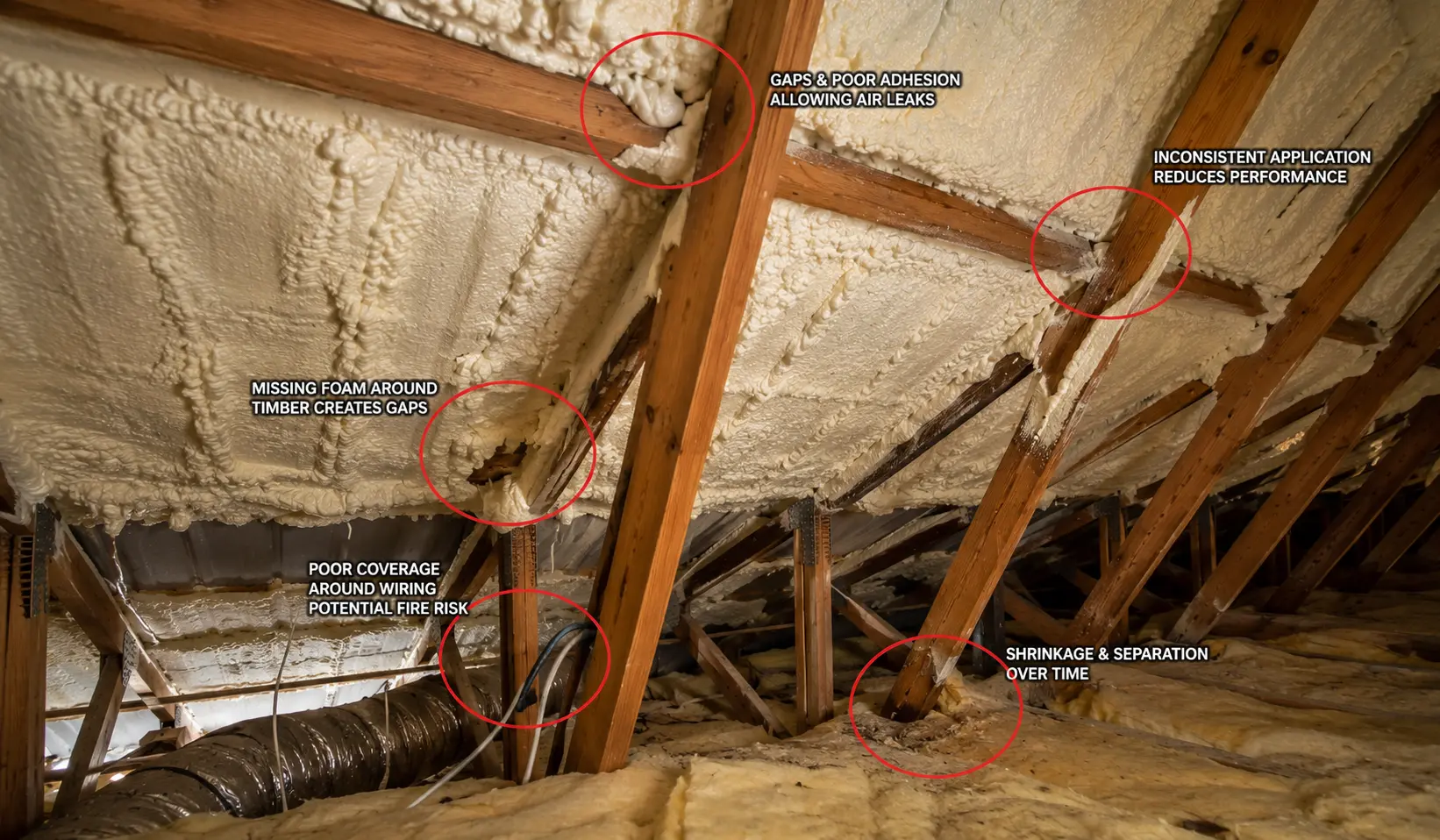
spray foam insulation problems usually come from poor installation, wrong product choice, or hidden building issues. Spray foam can perform very well, but it must be applied correctly.
Many property owners only hear the benefits. However, the risks matter too. In this guide, I explain the common problems, warning signs, and how to avoid costly mistakes.
Why Spray Foam Insulation Problems Happen
Spray foam is a high-performance insulation system. However, it is not a simple plug-and-play product. It depends on correct preparation, application, curing, and building assessment.
The first issue is poor surface preparation. Foam must bond to a suitable surface. If the roof, wall, or metal substrate has dust, oil, moisture, rust, or loose material, adhesion can fail. As a result, the foam may pull away later.
Another common issue is incorrect mixing. Spray foam is created when two chemical components react. If the ratio is wrong, the foam may not cure properly. Therefore, the final product can become soft, brittle, smelly, or unstable.
Temperature also matters during installation. The foam, substrate, and surrounding air must be within the right range. If conditions are unsuitable, expansion and curing may suffer. This is especially important in roof cavities and metal buildings.
In my experience, many spray foam insulation problems are not caused by the foam itself. They are caused by skipping the inspection stage. A professional should check moisture, ventilation, wiring, roof leaks, and access before spraying.
Product choice is another major factor. Open cell and closed cell foam are not the same. Open cell foam is softer and more flexible. Closed cell foam is denser and more resistant to moisture movement. Because of this, each one suits different uses.
A Brisbane home roof cavity has different needs from a warehouse roof. Likewise, a residential ceiling space is different from a metal shed. The installer must understand the building before recommending a product.
Poor communication can also create problems. The owner may expect foam to fix all heat, moisture, or noise issues. However, insulation is only one part of the building envelope. It can help, but it cannot repair structural defects.
For homes, the safest starting point is a proper site assessment. If the property is residential, review the service options for residential spray foam insulation in Brisbane before deciding.
The Most Common Spray Foam Insulation Problems in Roof Cavities
Roof cavities are one of the most sensitive areas for spray foam. They face heat, humidity, dust, wiring, and changing airflow. Therefore, roof applications need careful planning.
One common problem is trapping existing moisture. Spray foam should not be installed over active roof leaks. If the roof has damaged flashing, cracked tiles, or poor drainage, water can still enter. Consequently, moisture may stay hidden behind insulation.
Another concern is condensation. Spray foam can reduce air movement, which is often a benefit. However, airflow changes must be understood. If the roof design already has poor moisture management, insulation alone may not solve it.
Ventilation can also become a point of confusion. Some roof systems need controlled ventilation. Others perform better when the roofline is sealed properly. The right approach depends on the building design, climate, and foam type.
In Brisbane, roof heat can be intense. When I analyse roof spray foam projects, I look at heat transfer first. Then I consider condensation risk, access, services, and roof condition. That order helps avoid shortcuts.
Another issue is blocking access to services. Roof cavities often contain wiring, ductwork, exhaust fans, and other components. If foam is sprayed without planning, future maintenance can become harder. For that reason, access points must be considered before installation.
Overspray is another practical problem. Foam can land on areas where it does not belong. This may include wiring, mechanical parts, stored items, or roof hardware. A careful installer protects surrounding areas before spraying.
Poor thickness control can also reduce performance. Too little foam may leave weak points. Too much foam in one pass can affect curing. Therefore, application depth should match the product and the insulation goal.
Lo que he visto es simple. Roof foam works best when the installer respects the building first. If the roof is dry, suitable, and properly assessed, the result is usually stronger.
For roof-specific projects, it is important to understand how the system will work in that space. You can review our page on roof spray foam in Brisbane for more context.
Spray Foam Insulation Problems Caused by Moisture
spray foam insulation problems linked to moisture should be taken seriously. Moisture can affect timber, metal, plasterboard, and indoor air quality. Insulation should not hide water problems.
A roof leak must be fixed before foam is installed. Otherwise, the insulation may make the issue harder to detect. This is why inspection matters before any spray foam project.
Condensation risk also needs review. In some buildings, warm humid air can meet cooler surfaces. As a result, water droplets can form. Good design helps reduce this risk.
Odour, Off-Gassing, and Indoor Air Concerns
Odour is one of the most discussed spray foam concerns. A normal curing period may involve some smell. However, strong or persistent odour is not something to ignore.
Spray foam must be installed with the correct ratio, temperature, and ventilation. If the foam is mixed incorrectly, it may not cure as intended. As a result, odour can continue longer than expected.
Occupants should follow safety instructions during and after installation. The installer should explain re-entry times clearly. In many cases, the area should remain vacant while the foam cures.
Ventilation during installation is also important. Professional installers use equipment and procedures to manage application conditions. However, poor practice can increase odour complaints.
En mi experiencia, odour issues often point to process problems. The question is not only “what product was used?” The better question is “was it installed under the right conditions?”
Indoor air concerns also depend on building layout. A roof cavity, wall cavity, commercial ceiling, or enclosed room can behave differently. Therefore, each job needs its own plan.
Homeowners should avoid DIY spray foam kits for major areas. Small cans may help with minor sealing tasks. However, full insulation jobs require specialist equipment and training.
If a strong smell remains after the expected curing period, the area should be inspected. The installer may need to check curing, ventilation, and foam condition. In some cases, independent advice may also be useful.
Clear communication helps prevent stress. A professional should explain what to expect before work starts. They should also provide practical guidance after the job is complete.
Property Value, Insurance, and Lending Concerns
Some property owners worry that spray foam could affect resale, insurance, or finance. These concerns can be valid in some markets. However, they depend on local rules, product type, installation quality, and documentation.
In some cases, lenders or surveyors may ask questions about roof spray foam. Their concern is usually access and hidden roof condition. If foam covers roof timbers or structural elements, inspection can become more difficult.
That does not mean all spray foam is bad. It means documentation matters. Owners should keep records of the installer, foam type, application area, and project photos.
A poorly documented job can create uncertainty. Buyers may not know whether the roof was inspected first. Surveyors may not know whether the product was suitable. Consequently, they may flag the installation for review.
Cuando lo analice desde el punto de vista del propietario, la transparencia es clave. A good installation should not rely on guesswork. It should have clear information before and after the work.
Insurance questions can also arise after bad installations. If foam is installed over damaged wiring, wet timber, or hidden defects, problems may follow. Therefore, the building condition should be checked first.
Commercial properties have similar concerns. Warehouses and industrial buildings may need documentation for compliance, maintenance, or future modifications. Clear records can make later work easier.
For business properties, planning is especially important. You can review the service approach for commercial spray foam insulation Brisbane before making decisions.
The practical lesson is simple. Spray foam should be installed as a professional building upgrade, not a quick cover-up. If the job is assessed, documented, and applied correctly, future concerns are easier to manage.
How to Avoid Spray Foam Insulation Problems Before Installation
Most spray foam insulation problems can be reduced before the first spray pass. The key is preparation. A rushed installation creates risk.
Start with a building inspection. Check for roof leaks, moisture stains, mould, damaged surfaces, pests, and poor ventilation. If any issue exists, fix it before installing foam.
Next, confirm the right foam type. Open cell foam may suit some residential areas. Closed cell foam may suit other areas where density and moisture resistance matter. The installer should explain why one product is better for your project.
Ask about surface preparation. The installer should know whether the substrate is clean, dry, and stable. If they do not discuss preparation, that is a warning sign.
Also ask about thickness. Different areas need different application depths. A roof cavity, shed, warehouse, and wall cavity may require different approaches. Proper thickness supports performance and durability.
Safety procedures matter too. The installer should explain access, ventilation, protective equipment, and re-entry guidance. This is especially important for occupied homes.
Documentation should be part of the process. Ask for details about the product, application area, and installation recommendations. Photos can also help if the property is sold later.
En mi experiencia, the best projects start with honest advice. Spray foam is not perfect for every property. A good professional will say when repairs are needed first.
Avoid choosing only by price. A cheaper quote may skip inspection, preparation, or proper protection. In the long term, that can cost more than a quality installation.
Finally, make sure the scope is clear. The quote should identify the area, foam type, approximate thickness, and any exclusions. Clear scope reduces misunderstandings.
Warning Signs of a Poor Spray Foam Installer
A poor installer may promise that foam fixes everything. That is not realistic. Spray foam can help insulation and air sealing, but it cannot repair every building defect.
Another warning sign is no inspection. If someone quotes without understanding the property, risk increases. The installer should ask about leaks, access, ventilation, and building use.
Vague answers are also a concern. If the installer cannot explain product type, curing, safety, or thickness, be careful. Professional advice should be clear.
What to Do If Spray Foam Has Already Been Installed Badly
If foam has already been installed and you suspect a problem, do not panic. Start with observation and documentation. Take photos, note smells, record dates, and identify affected areas.
Look for visible signs first. Foam pulling away, crumbling, shrinking, or staying soft can indicate trouble. Moisture stains or new condensation should also be checked.
Do not cut out large sections without advice. Removing foam incorrectly can damage surfaces. It can also make diagnosis harder. Instead, arrange an inspection from a qualified professional.
If odour is the issue, improve ventilation where safe. However, persistent odour needs proper assessment. The cause may involve curing, ratio, moisture, or contamination.
If the issue involves water, find the source first. Roof leaks, flashing problems, plumbing leaks, or condensation may be responsible. Repairing the source is more important than covering symptoms.
Sometimes localised repairs are possible. Damaged sections may be removed and resprayed. However, the surface must be prepared again before new foam is applied.
In more serious cases, removal may be required. This can be labour-intensive. Therefore, prevention is always better than repair.
The main goal is to understand the root cause. Was the product wrong? Was the surface wet? Did the installer skip preparation? Once the cause is clear, the repair path becomes easier.
Can Spray Foam Insulation Be Removed?
Yes, spray foam can be removed. However, it is often difficult and time-consuming. The method depends on foam type, location, thickness, and surface material.
Removal may be needed when foam is wet, defective, badly applied, or blocking repairs. In other cases, small repairs may be enough. A professional inspection should guide the decision.
FAQs About Spray Foam Insulation Problems
What are the most common spray foam insulation problems?
The most common issues include poor adhesion, bad odour, moisture trapping, overspray, and incorrect thickness. Most problems come from poor preparation or installation.
Can spray foam cause roof problems?
Spray foam can create concerns if installed over leaks or damaged roof materials. However, a proper inspection helps reduce this risk. The roof should be sound before installation.
Is spray foam insulation safe?
Spray foam can be safe when installed correctly by trained professionals. The area must follow curing and re-entry guidance. Poor installation can create odour or air quality concerns.
Why does spray foam smell after installation?
Some smell can occur during curing. However, persistent strong odour may indicate poor mixing, curing issues, or ventilation problems. The area should be inspected if the smell continues.
Can spray foam trap moisture?
Yes, it can trap or hide moisture if installed over existing leaks or wet materials. That is why moisture issues must be fixed first. Proper product choice also matters.
Does spray foam affect home resale?
It can raise questions if poorly documented or badly installed. Buyers, insurers, or surveyors may want details. Good records and professional installation reduce uncertainty.
Should I remove bad spray foam insulation?
Removal depends on the problem. Local damage may be repaired. However, wet, defective, or badly installed foam may need removal after inspection.
How can I avoid spray foam problems?
Choose a professional installer, confirm the foam type, inspect the building first, and fix moisture issues. Also keep documentation after installation.
Final Advice Before Choosing Spray Foam
spray foam insulation problems are usually avoidable with the right process. The foam must match the building, and the building must be ready for the foam.
The biggest mistake is treating spray foam as a quick fix. It should be part of a planned insulation and air sealing strategy. That means inspection, preparation, correct application, and clear documentation.
In my experience, spray foam can be a strong solution for Brisbane properties. However, it needs professional judgement. If you want long-term performance, start with the right assessment.